How to Use CO2 in a Planted Aquarium
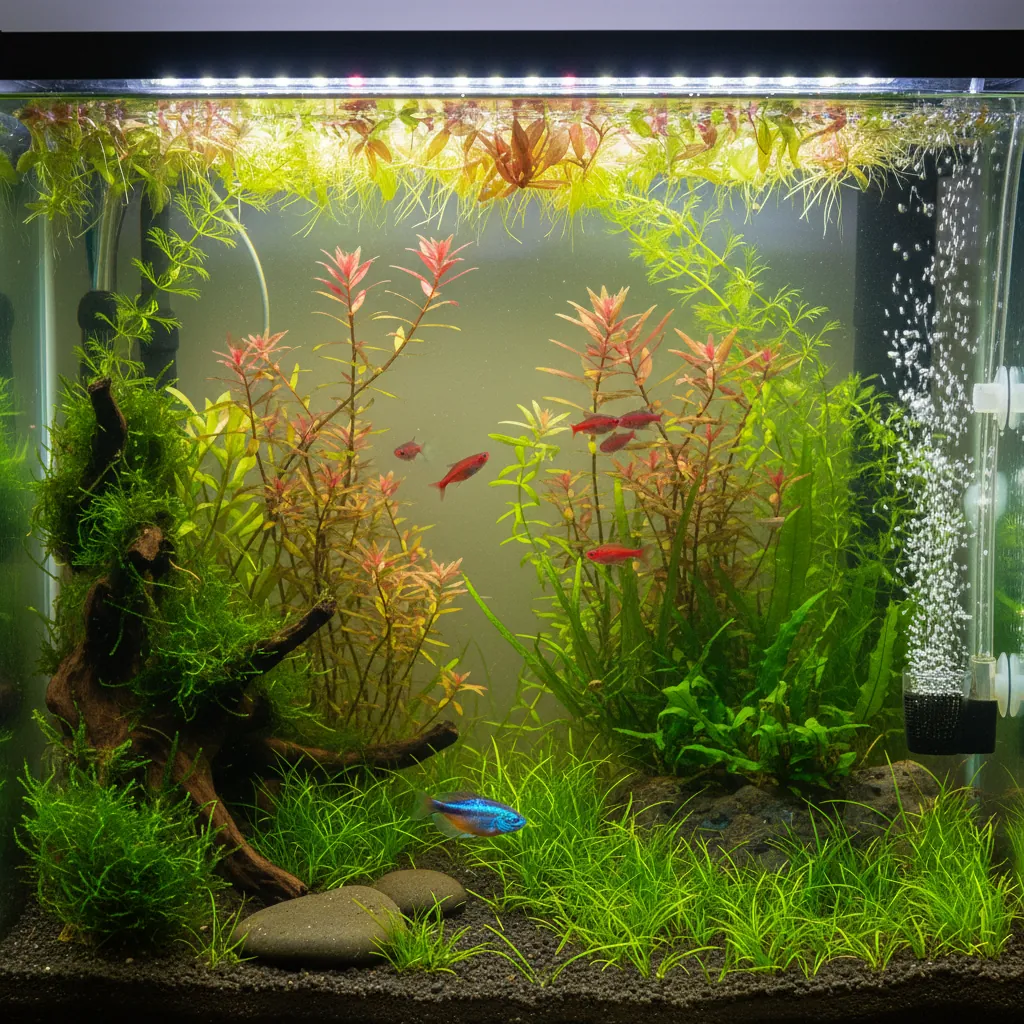
How to Use CO2 in a Planted Aquarium
Contents
- Quick Care Summary
- Why Do Planted Aquariums Need CO2?
- How Much CO2 Do Planted Tanks Need?
- Types of CO2 Systems for Planted Aquariums
- How to Set Up a CO2 System
- Common Problems and Solutions
Adding CO2 to a planted aquarium can significantly enhance plant growth and health, but it’s not always necessary. CO2 helps plants photosynthesize more efficiently, leading to faster growth and vibrant colors. Whether you need CO2 depends on your tank’s setup, plant species, and lighting. This guide covers CO2 options, benefits, and best practices for planted tanks.
Quick Care Summary
- Tank Size: Small to large aquariums (specific CO2 systems vary by tank size).
- Water Temperature: 20°C–25°C (optimal for CO2 fermentation).
- pH: 6.0–7.5 (CO2 lowers pH; monitor carefully).
- Diet: CO2 supplementation for plants; no fish diet changes required.
- Temperament: Safe for most fish if CO2 levels are controlled (below 30 ppm).
- Difficulty: Beginner-friendly systems (e.g., yeast-based) to advanced setups (e.g., pressurized CO2).
Why Do Planted Aquariums Need CO2?
Plants require CO2 for photosynthesis, converting it into energy for growth. In low-light tanks, ambient CO2 (3–5 ppm) is sufficient. However, high-light setups or tanks with advanced plants may need supplemental CO2 to prevent stunted growth and algae blooms. Without CO2, plants compete for limited resources, leading to slower growth and potential algae issues.
How Much CO2 Do Planted Tanks Need?
Optimal CO2 levels vary based on plant type and tank setup:
- Easy Plants (Anubias, Java Fern): 3–10 ppm.
- Medium Plants: 10–20 ppm.
- Advanced Plants: 25–30 ppm.
Fish safety is a priority; avoid exceeding 30 ppm, as higher levels can harm fish by reducing oxygen availability. Monitor CO2 levels using a drop checker or pH/KH relationship.
Types of CO2 Systems for Planted Aquariums
| System Type | Pros | Cons | Best For |
|---|---|---|---|
| Yeast Fermentation | Inexpensive, easy to set up | Short lifespan (2–4 weeks), inconsistent | Small tanks, beginners |
| Pressurized CO2 | Precise control, long-lasting | Expensive, complex setup | High-tech tanks, advanced users |
| Citric Acid/Baking Soda | Affordable, eco-friendly | Requires frequent refilling, manual setup | Mid-sized tanks, intermediate users |
| Low-Tech Methods | No additional equipment needed | Limited CO2 output (3–10 ppm) | Low-tech tanks, easy plants |
Key Recommendations:
- Beginners: Start with yeast-based systems like the Dennerle CO2 Starter Kit.
- Advanced Users: Invest in a pressurized CO2 system with a regulator and solenoid valve for precise control.
How to Set Up a CO2 System
Yeast Fermentation (Dennerle CO2 Starter Kit)
- Mix Bio CO2 powder with 300 ml water and let sit for 24 hours.
- Add Bio Activator with 200 ml water.
- Connect the CO2 diffuser to the tubing and place it in the tank.
- Adjust CO2 output to 1–2 bubbles per second for small tanks.
Pressurized CO2 (Tropica CO2 System Nano)
- Attach the regulator to the CO2 cartridge.
- Fill the diffuser chamber with water and connect it to the tubing.
- Mount the diffuser near the tank bottom using suction cups.
- Adjust the regulator for desired CO2 output (use a drop checker for accuracy).
Citric Acid/Baking Soda (FZONE CO2 Generator)
- Add baking soda to the generator bottle.
- Slowly pour citric acid solution (600g citric acid, 780g baking soda, 900ml water).
- Wait 24 hours for pressure to stabilize.
- Adjust the needle valve for consistent CO2 flow.
Common Problems and Solutions
Problem: Fish Gasping at the Surface
Cause: CO2 levels too high (>30 ppm).
Solution: Reduce CO2 output immediately and increase aeration.
Problem: Algae Blooms
Cause: Imbalance of light, CO2, and nutrients.
Solution: Ensure proper CO2 dosing and avoid prolonged lighting periods.
Problem: Slow CO2 Production
Cause: Depleted fermentation mixture or low temperature.
Solution: Refill or replace the mixture and maintain optimal room temperature (20°C–25°C).
FAQ
Do all planted tanks require CO2?
No. CO2 is essential for high-tech tanks with advanced plants but optional for low-tech setups with easy plants.
Can CO2 harm fish?
Yes, if levels exceed 30 ppm. Monitor CO2 carefully and use a drop checker for safety.
How long does a yeast-based CO2 system last?
Typically 2–4 weeks, depending on room temperature and fermentation activity.
What’s the difference between pressurized CO2 and DIY systems?
Pressurized CO2 offers precise control and longevity, while DIY systems (yeast or citric acid) are cheaper but require frequent maintenance.
How do I measure CO2 levels?
Use a CO2 drop checker or calculate CO2 based on pH and KH values.
Related guides
- Amazon Sword Care Guide: How to Grow Echinodorus in Aquariums
- Anubias Care Guide: Everything You Need to Know
- Best Aquarium Plants for Beginners: Hardy, Low-Light Choices
- Cryptocoryne Care: A Complete Guide to Thriving Aquarium Plants
- Dwarf Hairgrass Care: A Complete Guide